
Bridging the Gap Between Python and Rust in GPU Programming
Developers have long faced a difficult trade-off when writing high-performance GPU code. They must choose between the productivity of high-level languages like Python and the strict safety and control offered by systems languages like Rust.
A recent breakthrough changes this dynamic by demonstrating how autonomous AI agents can translate complex GPU kernels between different front-end languages. A specialized engineering team successfully ported production-grade machine learning operators from Python to Rust while maintaining near-native execution speeds.
The Role of cuTile Rust and CUDA Tile IR
The project centers on cuTile Rust, a framework designed to bring memory safety and the Rust ownership model to GPU kernel authoring. By splitting mutable outputs into disjoint pieces, the system preserves host-side ownership contracts across kernel launches.
However, writing these systems by hand is labor-intensive and error-prone. To scale adoption, the team built a multi-agent AI skill capable of translating cuTile Python and Triton-TileIR code directly into idiomatic cuTile Rust.
The translation process relies on a shared foundation known as CUDA Tile IR. Because cuTile Python, Triton-TileIR, and cuTile Rust all compile down to the same underlying intermediate representation, automated transformation becomes technically feasible and mathematically verifiable.
Automated Translation Pipeline and Benchmarking
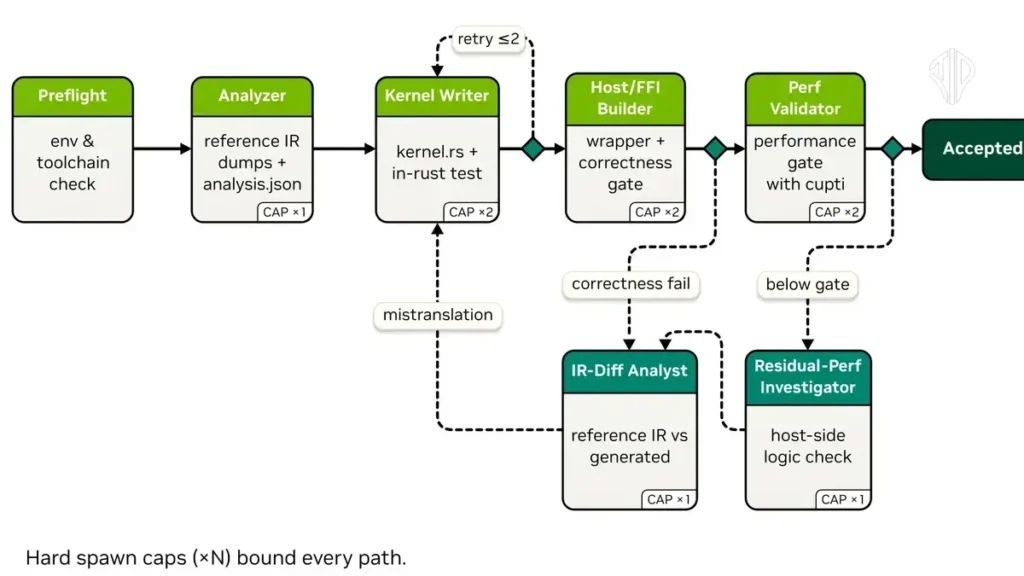
The multi-agent system operates through a bounded pipeline that handles analysis, device kernel generation, host code creation, and benchmarking. Every individual stage concludes with a machine-checkable verdict using validation scripts and intermediate representation diffs.
One of the primary challenges during translation involved handling type specializations. While Python’s just-in-time compilation implicitly specializes kernels at call time, Rust strictly requires explicit type declarations within the kernel signature.
Using this automated pipeline, the team ported all twenty-four public operators from the TileGym library to Rust. These operators comprise roughly forty distinct GPU kernels, including flash-attention decode, Multi-head Latent Attention, and mixture-of-experts models.
Benchmarking results indicate that the AI-translated Rust kernels achieve 99.5 percent of cuTile Python performance on average. This proves that automated migration can bridge the gap between rapid prototyping frameworks and secure systems-level codebases.
The agentic translation skill has been made publicly available in the TileGym repository. This allows developers to apply the same multi-agent pipeline to their own custom GPU kernels and machine learning workflows.
Key Takeaways
- Developers previously faced a trade-off between Python productivity and Rust safety when writing GPU code.
- The cuTile Rust framework brings memory safety and ownership models to GPU kernel authoring.
- A multi-agent AI pipeline successfully translates cuTile Python and Triton-TileIR code into idiomatic cuTile Rust using CUDA Tile IR.
- AI-translated Rust kernels achieve 99.5 percent of cuTile Python performance across twenty-four public operators.
- The agentic translation skill is publicly available in the TileGym repository for developer use.
Join Our Community
Join our community by subscribing to our Weekly Newsletter to stay updated on the latest AI updates and technologies, including the tips and how-to guides.
Also, follow us on Instagram (@tid_technology) for more updates in your feed and our WhatsApp Channel to get daily news straight to your Messaging App.
