

A landmark report released on March 5, 2026, by researchers Maxim Massenkoff and Peter McCrory, provides a high-resolution look at how artificial intelligence is moving from theoretical potential to real-world labor market disruption.
While many previous studies speculated on what AI could do, the sources introduce a new metric: “Observed Exposure”. This measure tracks actual usage data from professional settings to identify where AI is truly taking over tasks today.
The Top 10 Occupations in the “AI Crosshairs”
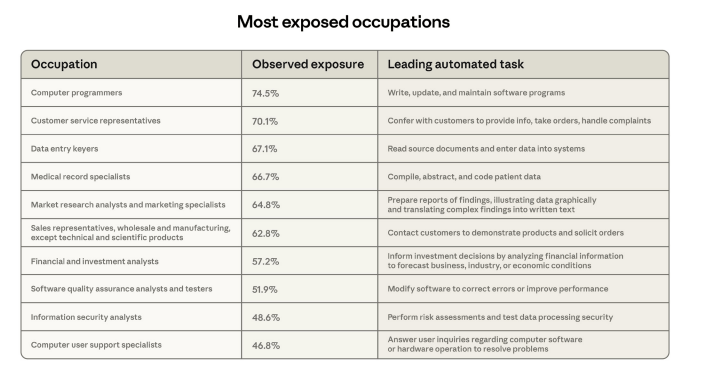
According to the source, certain professions are experiencing significantly higher rates of automated usage than the rest of the economy. At the very top of the list are Computer Programmers, with a 74.5% observed exposure rate, primarily driven by AI’s ability to write, update, and maintain software.
Customer Service Representatives follow closely at 70.1%, as companies increasingly use first-party APIs to handle inquiries and complaints.
Other highly impacted roles include:
- Data Entry Keyers (67.1%): Automating the reading and entry of source documents.
- Medical Record Specialists (66.7%): Compiling and coding patient data.
- Market Research Analysts (64.8%): Translating complex findings into reports.
- Financial and Investment Analysts (57.2%): Analyzing data to forecast economic conditions.
- Information Security Analysts (48.6%): Performing risk assessments and testing security.
The Gap Between Capability and Reality
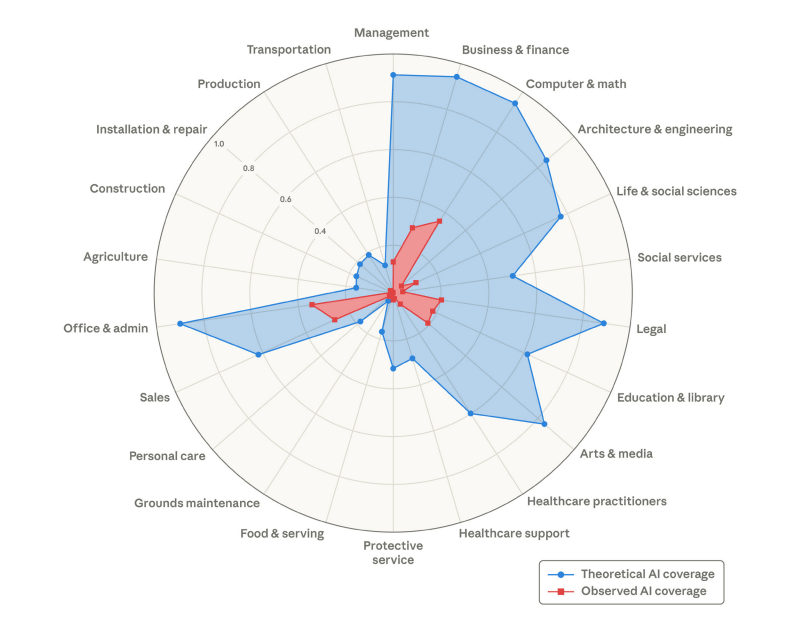
One of the most insightful findings in the sources is the significant “gap” between what AI is theoretically capable of and how it is actually being used. For instance, while LLMs could theoretically handle 94% of tasks in Computer and Math roles, current observed usage covers only about 33%.
This disparity exists because real-world deployment is often slowed by legal constraints, the need for human verification, or specific software requirements. Conversely, roughly 30% of workers—including cooks, bartenders, and motorcycle mechanics—have zero exposure because their physical tasks remain entirely beyond AI’s current reach.
Who is Most Exposed?
The sources highlight that the workers currently facing the most AI exposure are not those in traditional blue-collar roles, but rather highly educated, higher-paid, white-collar professionals.
Workers in the most exposed group are 16 percentage points more likely to be female, earn an average of 47% more than unexposed workers, and are nearly four times more likely to hold a graduate degree.
Impact on Young Workers
While the sources find no systematic spike in aggregate unemployment since late 2022, they reveal a troubling trend for the next generation. Hiring for younger workers (aged 22-25) has slowed significantly in high-exposure occupations.
Since the release of ChatGPT, there has been a 14% drop in the job-finding rate for this demographic in those fields. This suggests that while established professionals may be secure for now, the “entry-level” door is beginning to swing shut as AI absorbs foundational tasks.
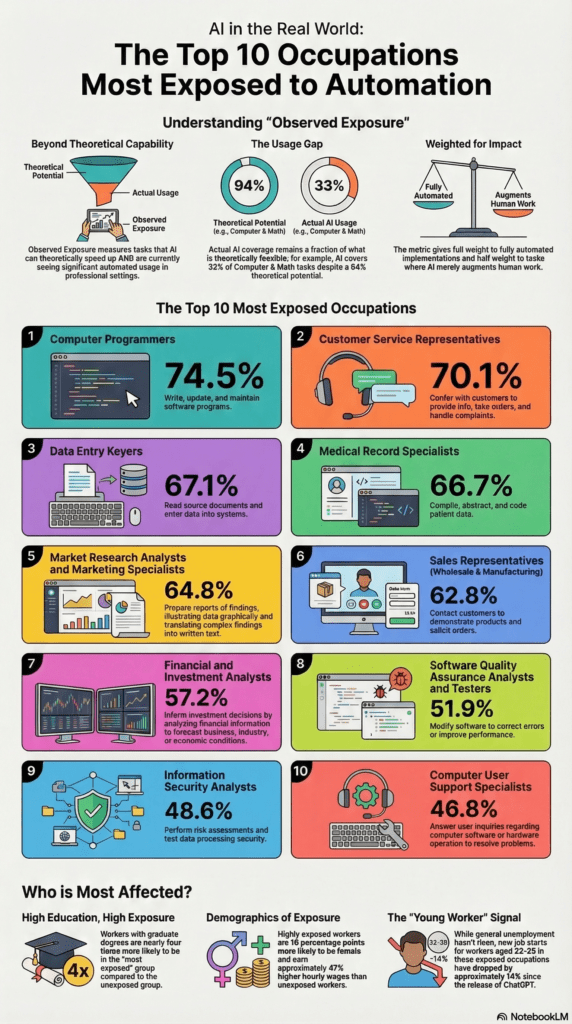
An Infographic depicting the Overview of the Report
Join our community by subscribing to our Weekly Newsletter to stay updated on the latest AI updates and technologies, including the tips and how-to guides.
(Also, follow us on Instagram (@tid_technology) for more updates in your feed and our WhatsApp Channel to get daily news straight to your Messaging App).
