
India’s enterprise AI landscape has reached a historic inflection point. No longer confined to innovation labs or exploratory documents, Artificial Intelligence (AI) and Generative AI (GenAI) are now deeply embedded in the operational fabric of corporate India.
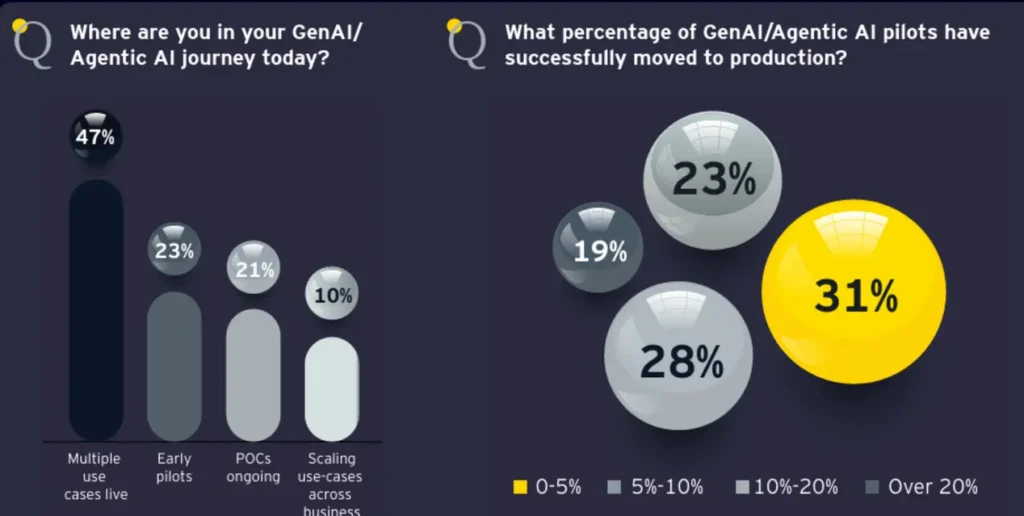
According to a survey of 200 Indian enterprise leaders conducted for the EY-CII report, “Is India ready for Agentic AI? The AIdea of India: Outlook 2026“, 47% of organizations now have multiple GenAI use cases live in production. This remarkable shift underscores that for nearly half of India’s large companies, AI adoption has decisively moved from pilots to performance.
Beyond the Pilot Stage: The 47% Leap
The adoption journey in Indian enterprises is characterized by ambition and impatience. The latest survey data reflects significant progress when contrasted with prior findings, which showed GenAI was largely in its infancy with limited real-world deployment.
Today, the statistics paint a picture of operationalization and scaling:
- 47% of organizations have multiple use cases live.
- 23% of respondents are still in the early stage/pilots.
- 10% are actively scaling use cases across the business.
This systemic embrace of AI across corporate India is palpable. Confidence in the technology’s potential remains high, with 76% of Indian business leaders believing that GenAI will have a significant business impact. Furthermore, 63% of leaders feel ready to leverage GenAI effectively. Indian businesses are innovating around limitations rather than waiting for perfect models.
Where AI is Making an Impact
The survey reveals that Indian enterprises are targeting AI interventions in core business functions that directly drive efficiency, experience, and growth.
The top three business functions prioritized for GenAI and Agentic AI use cases over the next 12 months are:
- Operations (63%)
- Customer Service (54%)
- Marketing (33%)
The emergence of mid- and back-office functions like operations and supply chain reflects a shift toward an agentic approach to implementation. Case studies from leading Indian enterprises show AI is moving from being a lab experiment to a growth engine, proving this shift from hype to hard numbers. For instance, Axis Bank has reported a 30% uplift in product conversions using GenAI assistants across its network.
Measuring the success of this shift requires a new approach, moving beyond simple cost reduction. AI’s impact is now viewed through a five-dimensional ROI model encompassing time saved, productivity gains, cost reduction, revenue generation (AI as a top-line driver), and strategic differentiation.
Speed is the New Currency
A striking finding from the survey highlights the urgency driving adoption: 91% of business leaders reported that speed of deployment was the single biggest factor driving their buying decisions (buy-vs-build). This reflects an impatience to translate innovation into measurable business impact quickly.
To achieve this rapid pace, Indian companies are moving away from insular, in-house-only approaches:
- Partnerships are Key: Partnerships with OEMs and startups are becoming the backbone of execution strategies. Nearly 60% of organizations now co-innovate with startups, recognizing their critical role in driving innovation and speed.
- Cloud Foundation: Agility and scalability are prioritized, with 71% of enterprises preferring hybrid cloud for GenAI and Agentic AI deployment.
The adoption of Agentic AI—autonomous software powered by GenAI that can accomplish goals independently—is fueling this shift. Forward-looking organizations are already rewiring their processes with agentic frameworks in a new wave of enterprise automation.
Navigating the Challenges of Scale
While the momentum is strong, the path to enterprise-wide AI scaling is not without hurdles. Organizations are grappling with several key constraints:
- Data Governance and Integration: Enterprises consistently rank data governance and security as a top concern, with 64.5% rating it “very severe”. Furthermore, 78% of respondents cite integration challenges (connecting GenAI systems to existing core workflows) as a top barrier.
- Investment Paradox: Despite strong conviction, funding for scaled AI transformation remains conservative. More than 95% of organizations allocate less than 20% of their IT budgets to AI. This imbalance suggests a need for greater financial commitment to match the high belief in AI’s transformative power.
- Workforce Transformation: The rise of AI is rewriting the architecture of work. Companies report selective displacement in outsourced and standardized functions (like customer service and back-office processes), leading to a structural shift in how work is organized. This necessitates upskilling employees to focus on creativity and judgment, turning career paths into lattices rather than ladders.
The progress reflected by the 47% deployment rate signals that India Inc. is focusing on realizing value now, preparing to transition from an AI-enabled approach to becoming AI-first, where human and AI collaboration is seamlessly integrated across every function by design. This decisive shift promises to unlock non-linear growth and reshape India’s competitive standing in the global AI landscape.
Imagine the Indian enterprise landscape as a massive fleet of ships. For years, many were testing prototype engines (pilots). Now, nearly half of those ships have installed powerful, multi-stage engines (multiple use cases live) and are full steam ahead, focusing on speed and strategic direction, rather than just tinkering at the dock. Their next challenge is ensuring the entire crew (the workforce) is trained to steer these powerful new vessels responsibly, while integrating all new systems seamlessly.
Key Takeaways
- Nearly half of India’s large companies have moved from AI pilots to live production use cases.
- Speed of deployment is the biggest driver in AI buying decisions.
- Data governance and integration are top challenges for scaling AI.
- Partnerships and cloud adoption are key strategies for rapid AI implementation.
- Workforce upskilling is crucial due to AI-driven job displacement in standardized roles.
Join our community by subscribing to our Weekly Newsletter to stay updated on the latest AI updates and technologies, including the tips and how-to guides.
(Also, follow us on Instagram (@tid_technology) for more updates in your feed and our WhatsApp Channel to get daily news straight to your Messaging App).