Imagine harnessing the very power that fuels our sun, not in the vast expanse of space, but right here on Earth. For decades, scientists and engineers have dreamt of controlling nuclear fusion, the process that powers stars, to provide a clean, virtually limitless energy source.
This ambitious dream is taking monumental shape in the hills of Provence, France, in the form of ITER—the International Thermonuclear Experimental Reactor. This colossal machine, a testament to global collaboration, represents humanity’s most significant gamble on unlocking the energy of the stars.
What is ITER? Unveiling the “Artificial Sun”
ITER is not just another scientific experiment; it is by every measure one of the most complex and ambitious machines humanity has ever attempted to build. Supported by 35 countries, including major global players like the United States, China, India, and members of the European Union, ITER embodies a rare fusion—both literal and metaphorical—of science, diplomacy, and sheer industrial ambition. Its core mission is to demonstrate the scientific and technological feasibility of fusion power at a scale that could be relevant for a future power plant.
Unlike nuclear fission, the technology used in today’s nuclear power plants, fusion offers a compelling vision for energy. It produces no long-lived radioactive waste, generates no greenhouse gases, and carries no risk of catastrophic meltdown. The fuel, derived from common isotopes of hydrogen found abundantly in seawater and lithium, is virtually limitless.
The Science Inside: How a Tokamak Works
At the heart of ITER lies a device known as a tokamak, a Russian acronym for a toroidal, or doughnut-shaped, chamber surrounded by powerful magnetic coils. Within this meticulously engineered vessel, hydrogen atoms will be superheated to an astonishing 150 million degrees Celsius—ten times hotter than the sun’s core. At such extreme temperatures, hydrogen gas transforms into a plasma, a hot, electrically charged state of matter where atoms shed their electrons.
Under immense heat and pressure, the nuclei of these hydrogen isotopes will collide and fuse, forming heavier elements and releasing a tremendous amount of energy in the process, primarily in the form of heat. This heat, while not directly generating electricity at the ITER facility, will prove whether sustained fusion at power-plant scale is indeed possible.
The project’s stated goal is to generate 500 megawatts of thermal power from just 50 megawatts of input—a tenfold energy gain, or Q = 10. This is a landmark no fusion reactor has ever achieved, with the current record holder, JET, having managed a Q of merely 0.67.
A Monumental Feat of Engineering and Collaboration
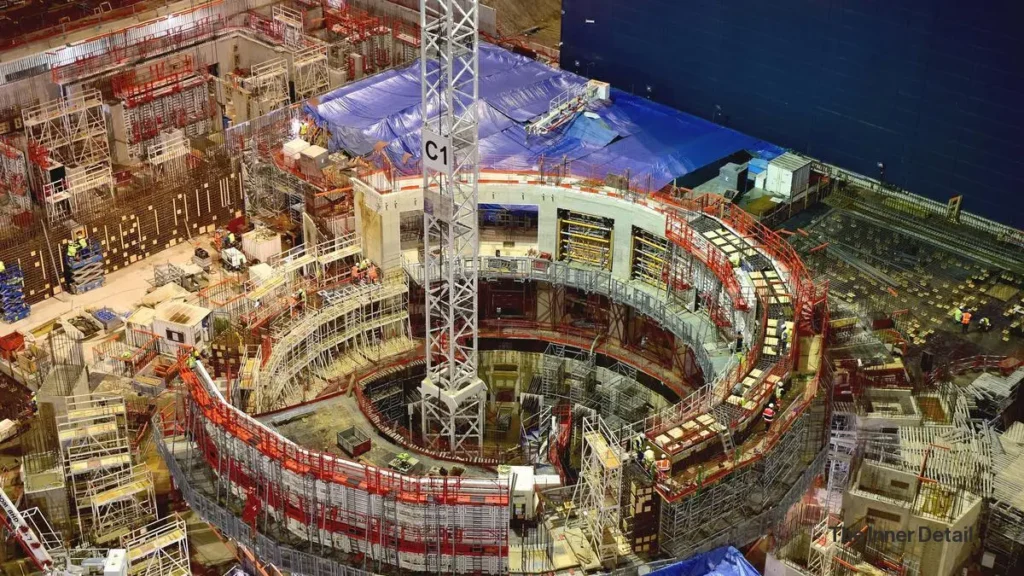
The sheer scale and precision required for ITER are mind-boggling. The central fusion chamber, known as the vacuum vessel, is currently undergoing final assembly. This involves welding together nine massive steel sectors, each weighing over 400 tonnes, with millimetric precision. These components, manufactured in South Korea and Europe, are shipped across continents before being meticulously integrated on site. Any deviation, even by a few millimeters, could compromise plasma containment and lead to mission failure. As the late director-general of ITER, Bernard Bigot, once stated, “Fusion doesn’t forgive engineering errors.”
ITER is often referred to as a “nuclear United Nations” due to its unparalleled international collaboration. Components ranging from superconducting magnets from the U.S. and cooling systems from India to sophisticated diagnostics from Japan, must integrate flawlessly. Over one million parts are being manufactured globally and converged at a single site in southern France, a logistical undertaking that rivals space missions in its complexity.
The central solenoid, for instance, an electromagnetic structure taller than a five-story building, will generate magnetic forces of 60 meganewtons—equivalent to twice the thrust of a space shuttle at launch, necessitating the creation of one of the most mechanically resilient structures ever built.
Current Status and the Road Ahead
The ITER project, backed by over $22 billion in investment and employing more than 5,000 people, has faced its share of challenges, including repeated delays and budget revisions since its original plasma experiment target of 2018. However, the momentum continues to build. The decisive phase of assembling the vacuum vessel is progressing, marking a significant step from theoretical designs to tangible, welded structures.
According to a baseline update published in July 2024, the revised timeline targets deuterium-tritium operation, where the reactor reaches its full power, by 2039. Prior to this, the project aims for “First Plasma” (the initial creation of hot plasma) earlier in the 2030s.
If ITER successfully proves the viability of fusion for power generation, the next step is already in planning. The European Union and Japan have initiated early-stage designs for DEMO, a demonstration fusion power plant. Expected to begin operation in the 2040s, DEMO would close the loop by converting fusion heat directly into electricity and delivering it to the grid.
The Promise and the Challenges
The stakes are incredibly high. With global electricity demand projected to grow by over 60% by 2050, fusion, with its near-limitless, clean fuel, could offer a crucial solution to our energy future. However, critics point to ITER’s extended timeline, immense costs, and the inherent uncertainties of such a pioneering endeavor. Private fusion startups are also emerging, claiming they can accelerate the path to fusion power with smaller, more agile designs. Yet, none have yet demonstrated sustained net energy gain.
For now, ITER remains the world’s best-funded and most advanced fusion project, meticulously working towards a future where the energy of the stars can illuminate our homes. It’s a decades-long bet on physics and engineering, transforming a grand scientific aspiration into an achievable reality.
Key Takeaways
- ITER is a global project aiming to demonstrate the feasibility of fusion power.
- Fusion offers a clean, virtually limitless energy source with no long-lived radioactive waste or greenhouse gases.
- The project faces challenges, including delays and high costs, but remains the most advanced fusion project.
- The goal is to achieve a tenfold energy gain (Q=10), surpassing previous fusion experiments.
- International collaboration is crucial, with components manufactured and integrated from over 35 countries.
Join our community by subscribing to our Weekly Newsletter to stay updated on the latest AI updates and technologies, including the tips and how-to guides.
(Also, follow us on Instagram (@inner_detail) for more updates in your feed and our WhatsApp Channel to get daily news straight to your Messaging App).