
As we move towards a more connected future, researchers have made a significant breakthrough, addressing a critical challenge within the rapidly expanding Internet of Things (IoT). The IoT envisions a world where various home appliances, from fans to lights, seamlessly connect to the internet. However, this connectivity traditionally requires a constant power source, either through batteries or direct power supplies. For consumers, the ongoing task of charging or replacing batteries in numerous smart devices can be a major inconvenience.
For widespread IoT adoption, a fundamental shift is needed: data transfer must occur efficiently in the background without reliance on external power. This necessity sparked the innovative concept of Wi-Fi Backscattering, allowing appliances and objects to communicate wirelessly using existing radio frequency (RF) signals, eliminating the need for dedicated power sources.
Transforming Appliances into Smart Devices.
Understanding Wi-Fi Backscattering Technology
The ability for batteryless devices to compute and communicate has been explored through tests using existing RF signals, such as those from radio and television broadcasts. These RF-powered devices convert the ambient RF signals into tiny amounts of electricity (hundreds of microwatts) to transmit data. However, these traditional RF-powered batteryless devices typically require a dedicated gateway, like an RFID reader, to connect to the internet. This is precisely where Wi-Fi Backscattering offers a revolutionary solution.
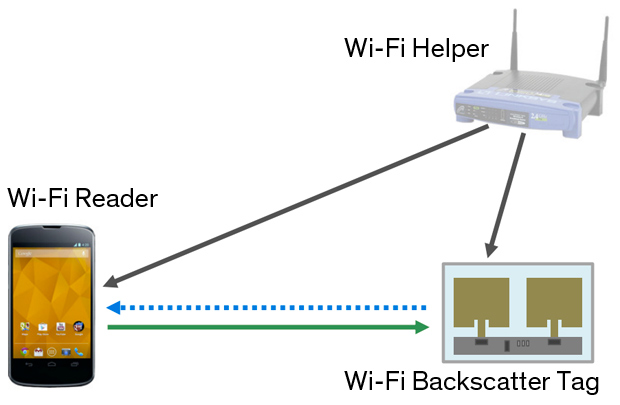
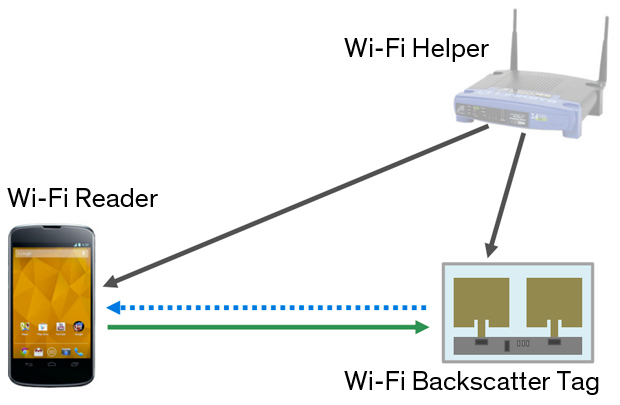
Wi-Fi Backscattering technology uniquely focuses on empowering any object to transmit data. It achieves this by seamlessly connecting RF-powered devices to the internet, critically reusing existing Wi-Fi signals without requiring any additional power supply for the devices themselves.
Traditional wireless technologies like Wi-Fi and Bluetooth typically consume significantly more power—two to three orders of magnitude more—than what can be harvested from ambient RF signals. This high power consumption presents a major hurdle for widespread IoT implementation. Recognizing this challenge, Joshua Smith and his team at the University of Washington’s Department of Electrical Engineering and Computer Science in Seattle have successfully prototyped an innovative solution for batteryless device connectivity. Their groundbreaking Wi-Fi Backscatter chips do not generate their own signals. Instead, they cleverly transmit data bits by either reflecting or not reflecting signals emitted by a standard Wi-Fi router. The varying strengths of these reflections can then be precisely analyzed and interpreted by readily available devices such as laptops, smartphones, and even other Wi-Fi routers.
“For the Internet of Things to truly revolutionize our daily lives, we need to ensure seamless connectivity for the potentially billions of battery-free devices that will soon be integrated into countless everyday objects,” stated Shyam Gollakota, an assistant professor of computer science and engineering at the University of Washington. He further emphasized, “We have now developed the capability to provide Wi-Fi connectivity to devices while drastically reducing power consumption by orders of magnitude compared to traditional Wi-Fi requirements.”
Exploring the Wi-Fi Backscattering Prototype’s Functionality
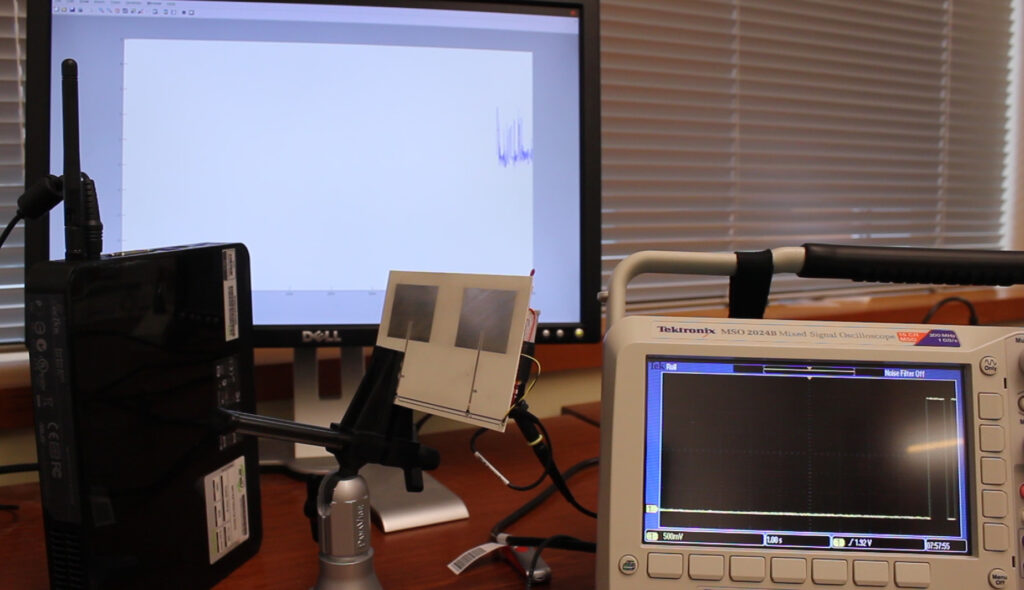
The innovative Wi-Fi backscattering prototype consists of several key components: a Wi-Fi backscattering reflector, an oscilloscope, a standard Wi-Fi router, and a computer screen. Data encoding occurs on the screen, directly reflecting the signal’s strength. When Wi-Fi signals are backscattered by the reflector, the resulting changes in signal strength are modulated at the receiving Wi-Fi device and then visually displayed on the screen. This groundbreaking method allows devices to operate using minuscule amounts of power, ensuring seamless internet connectivity and robust data sharing without compromise.
Read also : Time-travelling is now Paradox-free & possible
Initial tests demonstrate that the University of Washington’s Wi-Fi backscatter tag successfully communicates with a standard Wi-Fi device at data rates of 1 kilobit per second, maintaining a range of approximately 2 meters. Researchers are actively working to extend this range to about 20 meters and have already filed patents for this innovative technology.
Key Advantages of Wi-Fi Backscattering
- Wi-Fi Backscattering is poised to be a transformative force for the emerging IoT ecosystem, offering the potential to provide ubiquitous internet connectivity to virtually every device within your home.
- This technology naturally enhances Wi-Fi signal strength throughout your residence, ensuring robust connectivity in every corner.
- Envision your home’s walls acting as intelligent security monitors, providing advanced threat detection without additional power, far beyond traditional methods.
For a visual explanation of Wi-Fi Backscattering, watch this video:
References and Further Reading:
- https://www.washington.edu/news/2014/08/04/no-power-wi-fi-connectivity-could-fuel-internet-of-things-reality/
- https://spectrum.ieee.org/tech-talk/computing/networks/internet-of-things-talks-by-turning-reflective
- https://www.youtube.com/watch?v=snZWgAZqo2c
Join our community by subscribing to our Weekly Newsletter to stay updated on the latest AI updates and technologies, including the tips and how-to guides. Also, follow us on Instagram (@inner_detail) for more updates in your feed. For more such interesting informational, technology and innovation stuffs, keep reading The Inner Detail.






Pingback: Smart Home has to do more, mostly aims to save your money! – The Inner Detail