
A groundbreaking initiative launched by the Department of Telecommunications (DoT), which aims to increase public WiFi hotspots, and also to create a decentralized, micro-entrepreneurship model that transforms local shopkeepers into small-scale Internet Service Providers (ISPs).
Broadband connectivity is no longer a luxury confined to technical discussions; it has become a fundamental necessity for every individual seeking to connect with the rapidly evolving information world.
Recognizing its profound influence on social and economic development, governments globally are establishing public broadband networks. In India, despite growing connectivity, the internet broadband density in rural areas stands significantly lower, at 38 per 100 users. Bridging this digital divide is essential for improving literacy and driving economic growth across the country.
The PM-WANI (Prime Minister Wi-Fi Access Network Interface) Scheme is the Government of India’s strategic answer to this challenge. Launched on December 9th, 2020, PM-WANI aims to fulfill the goal set by the National Digital Communications Policy, 2018 (NDCP) to build a robust digital communications infrastructure.
PM-WANI: The Framework for Affordable Access
PM-WANI works by unbundling the traditional ecosystem of Wi-Fi operations and deployment, allowing multiple players to participate in offering affordable broadband services.
This innovative approach directly addresses affordability by allowing end users to purchase broadband access coupons in smaller denominations, ranging from just Rs. 6 to Rs. 20. The framework provides Broadband primarily through Public Wi-Fi Hotspot providers and relies on four key entities:
- Public Data Office (PDO): The ground-level operators who establish, maintain, and operate the Wi-Fi Access Points, delivering the crucial last-mile connectivity to subscribers.
- Crucially, a PDO is not required to pay any license fee or undergo any form of registration.
- Anyone, such as a tea-shop or kirana shop owner who has a customer base and space for installation, can become a PDO.
- A PDO needs to arrange an access point, power source, and internet bandwidth from existing ISPs/TSPs (like BSNL, RJio, or Vodafone).
- Public Data Office Aggregator (PDOA): The entity responsible for aggregating multiple PDOs. They manage the authentication, accounting, and aggregation of multiple PDOs, ensuring a seamless experience for the user.
- App Provider: Develops a dedicated application used to register users, authenticate potential broadband customers, and ‘discover’ and display nearby PM-WANI Wi-Fi hotspots. Startups and wallet providers are potential App Providers.
- Central Registry (CR): Maintained initially by the Centre for Development of Telematics (C-DoT), the CR manages the details of App Providers, PDOAs, and PDOs, and is responsible for certifying the software used by PDOAs and App Providers.
How PM-WANI Provides Low-Cost WiFi
The PM-WANI model achieves ultra-low-cost internet access through several smart, decentralized mechanisms:
- Zero License Fees for the Last Mile: By removing the requirement for PDOs to obtain a telecom license, the primary cost barrier to providing internet access is eliminated. A local shop owner simply needs an existing broadband connection and a WANI-compliant router to start a hotspot.
- Micro-Voucher System: Unlike expensive monthly mobile data plans, PM-WANI operates on a micro-sachet model. Users can buy ultra-affordable data plans, with some daily plans starting as low as ₹6 for 1 GB. This “pay-as-you-go” flexibility makes high-speed internet accessible to the urban poor and the rural population who cannot afford traditional monthly plans.
- Decentralized Revenue Sharing: The small investment (mainly the cost of the router and monthly broadband) is quickly offset by the revenue generated from selling these micro-vouchers. The PDO earns a significant share of every data plan sold, making it a viable additional source of income for local entrepreneurs. This creates a strong financial incentive for the rapid expansion of the network.
- Interoperability and Seamless Access: The unified PM-WANI architecture and the Central Registry enable roaming. A user’s purchased data pack can be used seamlessly across any WANI-compliant hotspot in the country, regardless of which PDO or PDOA runs it. This convenience makes it a true national public Wi-Fi grid.
How the Public can Use PM-WANI Wi-Fi
The core interaction for the end-user involves an application developed by an App Provider, which is one of the key elements of the PM-WANI framework.
Steps for Usage:
- Download the App: Users must download a PM-WANI Wi-Fi application, such as the Data Wani WiFi app, (or the App created by any PDOA) to connect to the internet.
- Registration and Discovery: The application is used to register users and helps them discover and display PM-WANI compliant Wi-Fi Hotspots (PDOs) that are in their proximity. The app allows users to find thousands of PDOs across India on a map.
- Authentication and Login: The application is designed to authenticate potential broadband users. After purchasing a plan, the user can log into the access point hosted by a Public Data Office (PDO).
The goal of this system is to provide broadband connectivity for all, including across gram panchayats and villages. Users are intended to experience seamless access to the internet, which helps strengthen the Digital India mission.
Features of the PM-WANI App
The App Provider develops the application to facilitate user interaction and access. Specific features include:
- Hotspot Discovery: The application helps users find and connect to thousands of Wi-Fi hotspots under the PM-WANI scheme. Users can find thousands of PDO hotspots in their locality and across India displayed on the map.
- User Management: The application enables users to register and authenticates them to access the internet services.
- High-Speed Connectivity: The app allows users to access high-speed Wi-Fi internet to watch movies and other content without interruption.
(For instance, Data Pm-Wani Application is used by users to register, discover, and display PM-WANI compliant Wi-Fi Hotspots for accessing internet services and authenticating users. The Data Pm-Wani WiFi app is cited as one of the first apps in Rajasthan certified by the Government of India as an App provider/PDOA under the scheme.)
Payment for PM-WANI Wi-Fi
The method of payment involves buying small digital plans:
- Coupon Purchase: The end user buys access in the form of coupons. These coupons are available in small denominations, ranging from Rs. 2 to Rs. 20 for broadband access.
- PDOA Portal Interaction: Whenever a user attempts to access a WANI compliant public Wi-Fi hotspot (PDO access point), they are automatically directed to the concerned PDOA portal.
- Online Payment: The PDOA portal offers various plans/coupons, allowing the user to select the desired value and make an online payment directly to the PDOA.
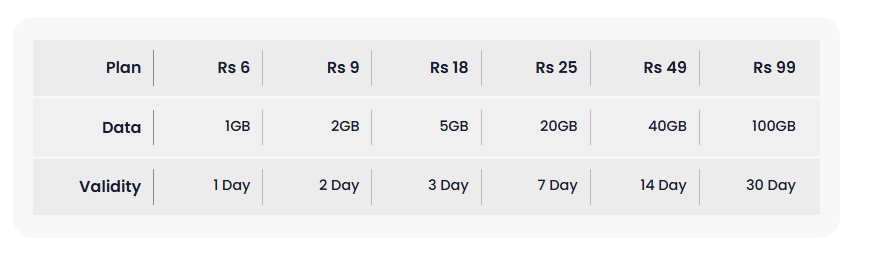
The PDOA collects the money and manages the user interface, tracking data consumption. After the purchase, the user can log into the PDO’s access point. Although the primary model involves buying coupons, visiting these hotspots through the application may sometimes allow users to get automatically connected to a safe and high-speed Internet for free.
Opportunity Knocks
The PM-Wani scheme not only is beneficial for public in getting low-cost Wi-Fi internet, but also provides opportunities for entrepreneurs and local shop owners to sell their Wi-Fi to people and customers and earn a share of it.
The scheme pulls people, local shop owners and entrepreneurs together in distributing internet at affordable cost. It facilitates two ways to be part of selling the Wi-Fi and earning income from it – 1) by becoming a PDOA / App provider 2) by becoming a PDO (anyone who has space to install Wi-Fi).
How to Become a Public Data Office Aggregator (PDOA)
The PDOA plays a central role, serving as the link between the PDOs and the customers. A PDOA functions much like services such as Ola (aggregating taxis) or Oyo (aggregating hotels), aggregating numerous access points (PDOs).
A PDOA earns revenue from PDOs by providing essential backend features, including plans, accounting, authorization, and a captive portal.
Here are the steps and requirements for becoming a PDOA:
- Registration and Licensing: A PDOA does not need to pay any license fees.
- Online Process: The PDOA must complete a simple online registration process at the Saral Sanchar Portal.
- Central Registry Sign-up: This registration is followed by signing up at the Central Registry.
- Software Procurement: A PDOA must procure a PM-WANI certified PDOA software stack, which is available commercially in the market. The Centre for Development of Telematics (C-DoT) also provides PM-WANI compatible software.
- Certification: Initially, a PDOA receives a provisional certificate based on a self-declaration document, allowing them to start providing services. Subsequently, the PDOA must seek full certification through a designated lab.
- Security Compliance: PDOAs must comply with defined security conditions, including making provisions for storing user data for one year for legal compliance. Furthermore, PDOAs must ensure user data privacy, and complete user data and usage logs must be stored within India.
For those seeking comprehensive details on the onboarding process, user manuals for PDOAs and App Providers are available for download on the PM-WANI website.
The Investment: Cost of Becoming a PDOA
The primary investment for a PDOA involves creating a complete backend system capable of handling internet plans/coupons, authorization and accounting (AA), payment collection, WANI token handling, and storage necessary for Lawful Interception (LI) compliance.
The PDOA has flexibility regarding its business model: solutions can be developed in an ownership model or sourced on a subscription basis under a service model. Hosting can be done on their own servers or through a cloud service provider.
The sources provide indicative typical costs, noting that these may vary based on market dynamics:
1. Ownership Model (Indicative Annual Cost)
In the ownership model, where the PDOA owns the infrastructure, resources needed include the server, PDOA software stack, internet bandwidth, payment gateway account, domain name, SSL Certificate, and manpower.
| Item (Example Costs) | Total Cost per annum (Rs.) |
|---|---|
| Server cost with OS and storage (Life: 5 years) | 32,000 |
| PDOA Software Stack (Amortized over 10 years) | 88,000 |
| Manpower Cost for operations | 336,000 |
| Break-even cost per month | 39,800 |
The total annual cost in the ownership model is estimated at Rs. 477,600.
2. Subscription/Service Model (Indicative Annual Cost)
In the subscription model, where resources are rented/subscribed to, the total annual cost is estimated at Rs. 442,400.
| Item (Example Costs) | Total Cost per annum (Rs.) |
|---|---|
| Cloud Cost (Hardware/OS/Bandwidth/storage as Service) | 112,000 |
| PDOA Software Stack (as Service) | 53,760 |
| Operation Manpower Cost (Skilled) | 268,800 |
| Monthly Cost | 36,866 |
(Note: These costs are indicative guides only, and the entrepreneur’s opportunity cost is not included.)
Driving Growth: Revenue-Sharing in PM-WANI
The revenue generation process begins when a user tries to access a WANI-compliant Wi-Fi hotspot (a PDO access point). The user is directed to the concerned PDOA portal, where they purchase a plan (coupon). Since the PDOA collects the payment online from the user, the PDOA retains a negotiated share of this revenue based on the agreement with the PDO. The remaining funds are paid back to the PDOs based on the internet usage.
The revenue share varies, depending on the specific services and support the PDOA provides to its PDOs. For typical projections, a share of 90:10 between the PDO and the PDOA is often assumed.
A PDOA’s potential earnings are directly proportional to the number of PDOs aggregated. Based on assumed revenue per PDO, projections show the financial viability of the PDOA business:
| No. of PDOs served | Total revenue generated per month (Rs.) | Share of PDOA per month (10%) (Rs.) |
|---|---|---|
| 100 (First 3 months) | 405,000 | 40,500 |
| 500 (First 6 months) | 2,025,000 | 202,500 |
| 5,000 (1 year) | 20,250,000 | 2,025,000 |
Crucially, the PDOA can break even and cover all its costs (including a 12% return on invested funds) if it serves approximately 100 PDOs. The more PDOs aggregated by a PDOA, the higher its profit and earnings will be. Know more about PDOA.
PM-WANI creates a decentralized, entrepreneurial pathway to democratize internet access. It operates like a vast, digital marketplace for micro-hotspots. Just as a farmer’s market aggregates individual small producers (PDOs) under a common regulatory and payment structure (PDOA/CR), PM-WANI ensures that small entrepreneurs can deliver affordable services directly to consumers, rapidly expanding connectivity where traditional large infrastructure might struggle.
Know how to become a PDO and generate income out of providing Wi-Fi Internet for public.
Key Takeaways
- PM-WANI aims to increase public WiFi hotspots and create micro-entrepreneurship opportunities.
- The scheme allows users to purchase affordable broadband access coupons, ranging from Rs. 6 to Rs. 20.
- Key entities in the PM-WANI framework include Public Data Offices (PDOs), Public Data Office Aggregators (PDOAs), App Providers, and a Central Registry.
- The model achieves ultra-low-cost internet access by removing license fees for PDOs and implementing a micro-voucher system.
- Becoming a PDOA involves online registration, software procurement, and compliance with security conditions.
Join our community by subscribing to our Weekly Newsletter to stay updated on the latest AI updates and technologies, including the tips and how-to guides.
(Also, follow us on Instagram (@tid_technology) for more updates in your feed and our WhatsApp Channel to get daily news straight to your Messaging App).