
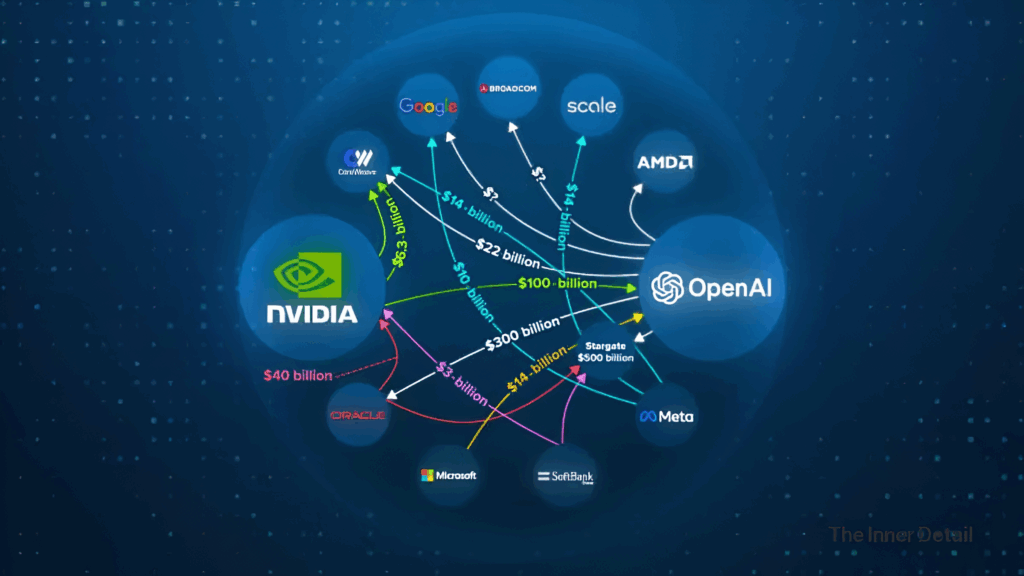
The current AI boom is characterized not only by rapid technological advancement but also by an unprecedented surge in infrastructure investment and interconnected corporate deals. The sheer scale of this buildout, often costing “trillions” of dollars for physical infrastructure, has led to creative, massive, and sometimes controversial partnerships between major players like OpenAI, Nvidia, and AMD. These relationships highlight a complex web where company fates are increasingly bound together.
The Mega-Partnerships for Compute Capacity
OpenAI, an AI research and deployment company focused on ensuring artificial general intelligence benefits all of humanity, requires massive compute power to realize AI’s full potential and accelerate progress. To meet these demands, OpenAI has struck landmark agreements with the world’s leading chip manufacturers, NVIDIA and AMD.
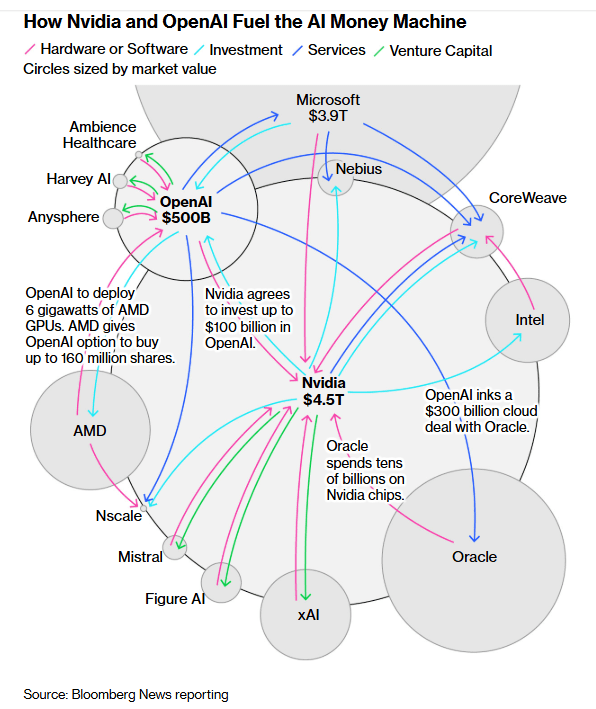
In September 2025, OpenAI and NVIDIA announced a strategic partnership to deploy at least 10 gigawatts of NVIDIA systems for OpenAI’s next-generation AI infrastructure, representing millions of GPUs. This deployment is scheduled to begin in the second half of 2026, leveraging the NVIDIA Vera Rubin platform. To support this massive commitment, NVIDIA intends to invest up to $100 billion in OpenAI, progressively investing as each gigawatt is deployed. Both companies view this as the “next leap forward” in intelligence.
Just weeks later, OpenAI announced a similar definitive agreement with AMD, a core strategic compute partner. This multi-year, multi-generation agreement involves deploying 6 gigawatts of AMD GPUs to power OpenAI’s AI infrastructure. The initial 1 gigawatt deployment will utilize AMD Instinct™ MI450 Series GPUs and rack-scale AI solutions, starting in the second half of 2026. This partnership is expected to deliver tens of billions of dollars in revenue for AMD.
The Circular Flow of Cash and Chips
Beyond simple supplier agreements, these deals involve deep strategic and financial alignments, sometimes criticized for their circular nature.
The partnership between AMD and OpenAI, for instance, involves AMD issuing OpenAI a warrant for up to 160 million shares of AMD common stock. These shares are structured to vest as purchases scale up to 6 gigawatts, as well as upon achieving specific share-price targets for AMD and technical/commercial milestones for OpenAI. This arrangement positions OpenAI to become one of AMD’s largest shareholders, deeply aligning their strategic interests.
A similar, complex web surrounds NVIDIA and OpenAI:
- NVIDIA committed to investing up to $100 billion in OpenAI.
- OpenAI subsequently struck a separate $300 billion deal with Oracle to build out data centers.
- Oracle, in turn, is spending billions on NVIDIA chips for those new facilities, effectively sending money back toward OpenAI’s prominent backer.
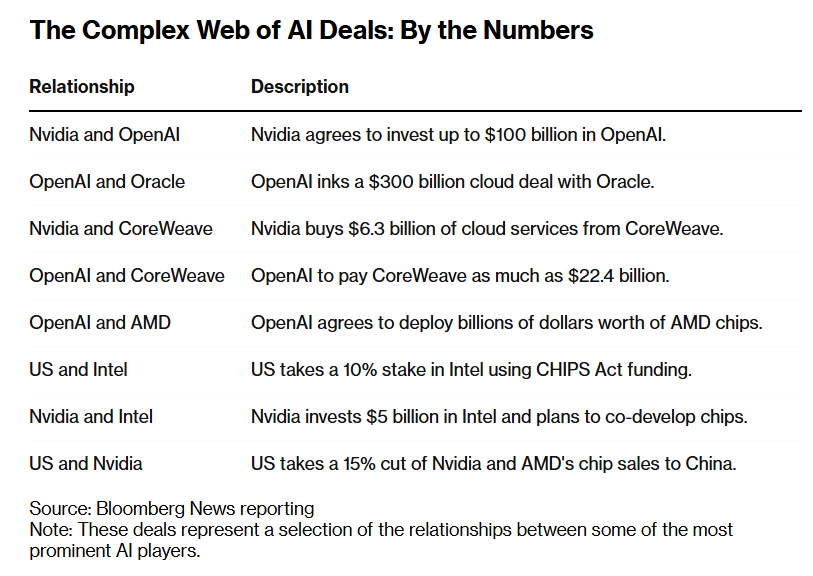
This interconnected structure is also evident in other major deals. For example, NVIDIA invested in CoreWeave Inc. and later agreed to purchase $6.3 billion worth of cloud services from the company, which rents out access to NVIDIA chips. Meanwhile, OpenAI received $350 million in equity from CoreWeave and expanded its cloud deals with the company to as much as $22.4 billion, further tying OpenAI and NVIDIA together through a shared vendor.
Even Elon Musk’s xAI is involved in this cycle, with NVIDIA planning to invest up to $2 billion in equity in a financing round structured via a special purpose vehicle (SPV) that would be used to buy NVIDIA processors, which xAI would then rent out.
Virtuous Cycle or Looming Bubble?
Executives defend these unorthodox business relationships as essential for meeting the massive, unprecedented demand for AI services and computing power. Dr. Lisa Su, CEO of AMD, referred to the OpenAI partnership as a “virtuous, positive cycle”. Greg Brockman, co-founder of OpenAI, emphasized that building the future of AI requires “deep collaboration across every layer of the stack”.
However, critics and analysts have expressed concerns, seeing uncomfortable similarities to the late 1990s dot-com bubble, where circular deals were used to inflate perceived growth. The current wave of deals is escalating concerns that this interconnected web is artificially propping up the trillion-dollar AI boom. The spending by top AI companies is far outpacing that of dot-com era startups, with OpenAI aiming to spend trillions on infrastructure despite not expecting to be cash-flow positive until near the end of the decade.
NVIDIA, as the dominant chip provider, holds a powerful financial position, allowing it to continue investing heavily in the ecosystem. The company states that it does not require the companies it invests in, such as OpenAI, to purchase its technology. Regardless of the debate surrounding valuation risk, the intertwined relationships between OpenAI, AMD, and NVIDIA demonstrate a fundamental shift: the development of next-generation AI requires massive, cooperative infrastructure commitments that bind the financial and strategic destinies of these industry giants together.
Key Takeaways
- AI development requires massive infrastructure investment, leading to large-scale partnerships.
- Deals between OpenAI, NVIDIA, and AMD involve complex financial alignments.
- Critics worry about similarities to the dot-com bubble due to circular investment structures.
- These partnerships mark a shift towards cooperative infrastructure commitments in AI development.
Join our community by subscribing to our Weekly Newsletter to stay updated on the latest AI updates and technologies, including the tips and how-to guides.
(Also, follow us on Instagram (@inner_detail) for more updates in your feed and our WhatsApp Channel to get daily news straight to your Messaging App).