If you are one of the over 40 million people who use Grammarly every day, you might not think of yourself as using AI, but you have been for years. Grammarly’s success was built on delivering writing help so ubiquitous and automatic that it felt “ordinary,” working tirelessly in every text box and application without needing to be asked.
Now, the company behind this trusted technology is undertaking a fundamental shift, expanding far beyond writing assistance. Announced on October 29, 2025, the company formerly known as Grammarly is rebranding its corporate name to Superhuman, positioning itself as an AI-native productivity platform. This move is a major bet on Agentic AI—a shift that promises to unlock “superhuman potential” in everyone.
From Grammarly to Superhuman
While the Grammarly product will continue to exist, the company name change to Superhuman reflects a grand new ambition. The CEO, Shishir Mehrotra, explained that the name reflects the belief that AI should amplify human capability, rather than forcing people to adapt to AI’s limitations or replacing human effort entirely.
The foundation for this platform has been years in the making. Grammarly had to lay down “rails” in thousands of apps and tune its AI to provide instant suggestions, creating a complex infrastructure to deliver AI quickly and reliably in every app. However, until now, Grammarly was the only “agent on the tracks”.
With the rebrand, Superhuman is expanding its offering from a single product to a comprehensive suite that leverages a whole team of agents to help users write, research, automate tasks, anticipate feedback, and schedule meetings. The core vision is to embed AI so naturally into the way people work that using it feels ordinary, eliminating the need to pause, prompt, or paste information.
Unveiling the Superhuman Suite
The new Superhuman company unites three existing brands—Grammarly, Coda, and Superhuman Mail—into one bundled, AI-native productivity platform. The Superhuman suite, available today on paid plans, includes four key products:
- Grammarly’s trusted writing partner: This continues to provide clear writing assistance.
- Coda’s all-in-one workspace: Acquired earlier this year, Coda provides AI-native workspaces for collaboration. Soon, Coda will process meeting notes into action items, offer to assign them, and draft documents instantly based on conversations.
- Superhuman Mail’s intelligent inbox: Also acquired earlier this year, this tool organizes inboxes and drafts replies. It will soon incorporate context from your CRM and other tools into auto-drafted replies, responding to priorities and schedule shifts.
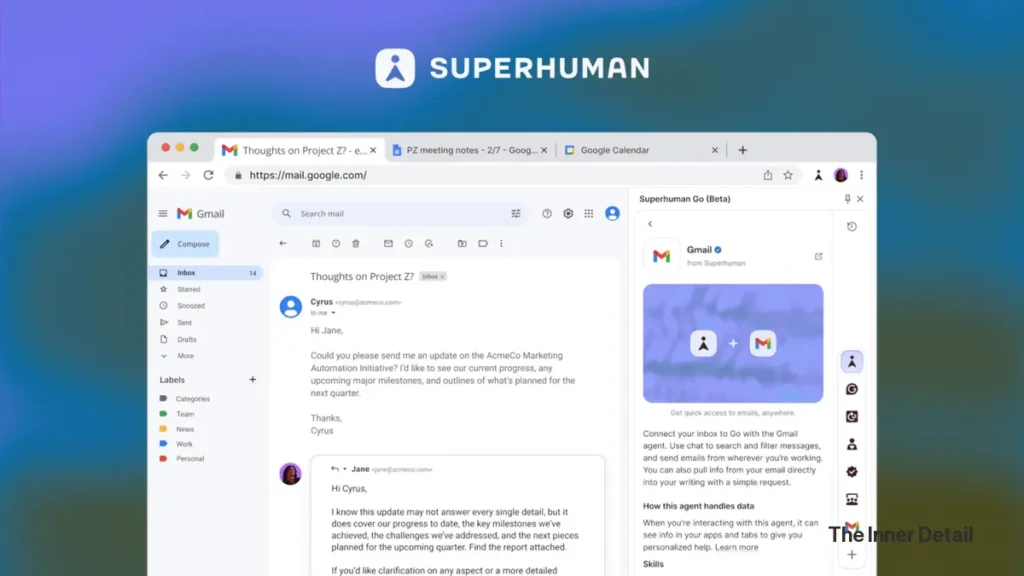
- Superhuman Go: The brand-new AI assistant that coordinates data and agents and offers timely assistance wherever work occurs.
Superhuman Go: The Proactive AI Agent at Your Side
Superhuman Go is the centerpiece of the new platform, designed to eliminate the “AI productivity gap”. Traditionally, AI tools work in isolation, forcing workers to manually input context and prompt repeatedly across disconnected apps. Go eliminates this context gap by bringing AI directly into the flow of work, connecting to over 100 apps including Google Workspace, Microsoft Outlook, Jira, and Confluence.
Superhuman Go’s special quality is that it works in all the apps you already use and helps without you needing to ask. The Chief Product Officer, Noam Lovinsky, noted that Go acts as an “AI partner that’s actively working with you,” rather than a tool you have to remember to use.
Examples of how Go operates include:
- Contextual Emailing: When drafting an email to a customer, Go can activate multiple agents to fine-tune the language, pull relevant product pricing from your CRM, and flag recent support issues so you can acknowledge the hiccup, ensuring teams have the necessary information everywhere they write.
- Meeting Automation: If you are deep in a chat thread that needs synchronous discussion, Go can find everyone’s availability and book the meeting automatically. If someone suggests scheduling a meeting in a conversation thread, Go will surface your availability and help you book it instantly.
- Workflow Delegation: Go can summarize a customer issue and file a bug report for the engineering team, allowing them to start fixing it immediately.
The Open Agent Ecosystem
Superhuman is embracing an open platform, launching with a range of built-in and partner-developed AI agents in the Superhuman Agent Store. These agents retrieve information, generate content, and provide expert feedback.
Key agents within Go include:
- Connector Agents: These agents bring real-time context from existing tools like email, chat, and documents (including Google Workspace, Microsoft Outlook, and Atlassian Jira and Confluence).
- Grammarly Writing Agents: These specialized agents provide targeted assistance, ranging from checking originality to predicting reader reactions.
- Partner Agents: Specialized agents from trusted external partners include Common Room, Radical Candor, Latimer, Fireflies, Parallel, Quizlet, and Speechify. More partners are expected, such as Saifr, Axios HQ, and Napkin AI.
Furthermore, Superhuman is rolling out the Superhuman Agents SDK in a closed developer beta, which will allow organizations and developers to build their own connected agents trained on their company’s data. These custom agents can proactively provide information and take action across the millions of applications and websites where Go works.
Availability and Commitment to Trust
The full Superhuman suite is available now on paid plans.
To allow users to experience the new proactive AI assistant, Superhuman Go features (along with connector and partner agents) are currently available at no additional cost until February 1, 2026. Go is available today on Grammarly’s browser extensions for Chrome and Edge, with Mac and Windows versions slated for release soon.
For existing customers of Grammarly, Coda, and Superhuman Mail, the core products they rely on remain unchanged, but they gain access to new capabilities that make everything work together better.
Crucially, Superhuman is built on Grammarly’s best-in-class security practices and commitment to user trust. The company assures users that it does not sell or monetize user content, users remain in control of their data, and third-party service providers are not allowed to train their models on user content.
In essence: If Grammarly was the foundation for making better writing effortless, Superhuman is the structure built upon it, creating a unified operating system where multiple AI helpers (agents) work invisibly across your entire workflow. It’s like upgrading from having a single, specialized wrench for typing to having a full, mobile AI toolbox that anticipates the next step in any task, whether that’s drafting a critical email or scheduling a high-stakes meeting.
Key Takeaways
- Grammarly is rebranding to Superhuman, an AI-native productivity platform.
- The Superhuman suite unites Grammarly, Coda, and Superhuman Mail.
- Superhuman Go is a new AI assistant that works proactively across multiple applications.
Join our community by subscribing to our Weekly Newsletter to stay updated on the latest AI updates and technologies, including the tips and how-to guides.
(Also, follow us on Instagram (@inner_detail) for more updates in your feed and our WhatsApp Channel to get daily news straight to your Messaging App).