
Building software with artificial intelligence has largely meant stitching chatbots, auto-complete utilities, or workflow assistants into pre-existing human pipelines. A team at NVIDIA recently explored this engineering paradigm shift by developing an open-source library named TensorRT Model Connect. Instead of using AI merely to accelerate a traditional development process, the creators set out to design a serious, production-grade system around coding agents from day one.
The project began with a practical goal: making the high performance of the NVIDIA inference stack accessible to developers who are not experts in TensorRT. However, as the project evolved, it transformed into an exploration of what it truly means to be AI native. Rather than relying on massive orchestration layers or sprawling prompt libraries, the team discovered that success depends on deliberate architectural choices, strict operational boundaries, and rigorous automated validation.
The Operational Meaning of AI Native
In the context of modern software development, the term AI native is often thrown around as a marketing buzzword. For the TensorRT Model Connect team, however, it adopted a strict, operational definition. An AI-native project treats model outputs as modular, verifiable units of work rather than definitive blocks of final code.
This operational approach acknowledges that AI models possess inherent unpredictability. By isolating these units of work, engineers can prevent errors from cascading throughout a massive codebase. This system does not mean that AI writes everything, nor does it eliminate human oversight.
Instead, it establishes a production pipeline capable of generating multiple candidate changes and subjecting every single one to rigorous, repeatable quality control. Compute handles the heavy lifting of creating code candidates, while automated testing, benchmark comparisons, and human reviews decide what is ready to ship.
Scaling Horizontally and Managing Complexity
Some engineering workflows are defined by long, serial critical paths where every step depends on the completion of the previous one. Others comprise many independent workstreams. Introducing AI coding agents yields vastly superior results in the second category, where tasks can be executed in parallel.
The long tail of AI models offers a natural fit for this horizontal scaling strategy. Model families, runtime paths, configurations, and validation cases can be investigated independently without blocking progress elsewhere. TensorRT Model Connect manages this by using family-owned reference implementations that translate Hugging Face or local checkpoints into versioned artifact bundles.
These bundles then expose task-oriented native C++ application programming interfaces for diverse workloads like vision, text, audio, diffusion, and forecasting. By focusing on problems that decompose cleanly into parallel units, the project avoids the coordination overhead and error cascades that plague serial development pipelines.
Outcomes Over Recipes
When working with general-purpose coding agents, developers frequently fall into the trap of prescribing every implementation step through highly detailed prompts and rigid recipes. The TensorRT Model Connect team took a fundamentally different route by providing agents with high-level outcomes and objective reference points instead.
A typical agent run begins with a clear goal, such as supporting a new model family, closing an accuracy gap, or strengthening an execution contract. The criteria required to accept the result are established up front, utilizing behavior from established reference implementations alongside project-specific constraints.
This approach gives capable coding agents the freedom to leverage patterns they have already learned during training. The implementation path remains flexible, but the acceptance criteria remain absolute. The agent is permitted to explore, test, fail, and revise within an isolated task, provided the final contribution passes the exact same architectural gates applied to human engineers.
Architectural Isolation as a Scaling Unit
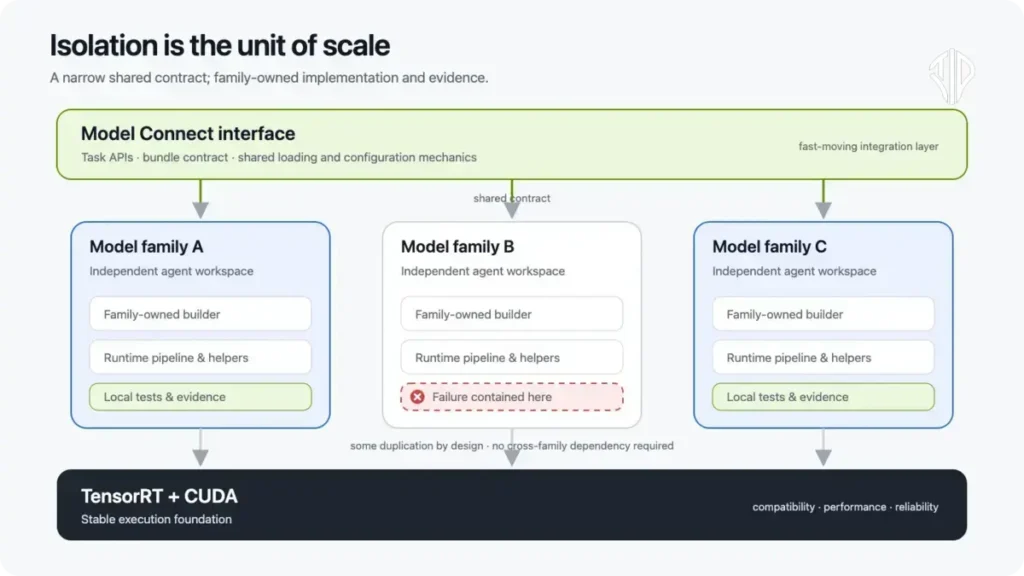
The most critical factor in scaling AI-native development is not the raw capability of the coding agent, but the surrounding software architecture. Components that evolve at radically different speeds must be cleanly separated to prevent maintenance bottlenecks.
In TensorRT Model Connect, the software layers are strictly partitioned:
- The execution foundation consists of TensorRT and CUDA, prioritizing long-term contracts, reliability, and performance.
- The faster-moving integration layer connects a rapidly expanding model ecosystem directly to the core execution foundation.
- Model-family implementations maintain their own specific knowledge, including builders, runtime pipelines, and validation evidence.
While shared abstractions can sometimes reduce overall code volume, they frequently couple unrelated tasks, increase merge conflicts, and amplify the blast radius of errors. Accepting some redundancy between isolated model families is a worthwhile trade-off to achieve smooth horizontal scaling.
Validation as the Ultimate Production Constraint
When software can be generated at an accelerated rate by automated coding agents, the traditional bottleneck shifts away from writing code and directly toward validation. If a system can produce hundreds of candidate implementations in a single day, the engineering team must have absolute confidence in their automated testing infrastructure.
For TensorRT Model Connect, automated validation acts as the final arbiter of quality. Reference comparisons, performance benchmarks, and strict correctness tests form a mandatory barrier between generated code and production releases. Architecture and validation together determine whether increased output translates into reliable software or simply technical debt.
Ultimately, designing software for the age of artificial intelligence requires treating compute as a generative engine and human judgment as a system of rigorous governance. As more engineering teams adopt agentic workflows, the lessons learned from building modular, isolated, and heavily validated pipelines will serve as a foundational roadmap for the future of software engineering.
Key Takeaways
- AI-native development treats model outputs as modular, verifiable units of work rather than definitive blocks of final code.
- Horizontal scaling allows model families and runtime paths to be investigated independently without blocking progress.
- Focusing on high-level outcomes and strict acceptance criteria gives coding agents flexibility while maintaining rigorous standards.
- Architectural isolation prevents error cascades and maintenance bottlenecks between components evolving at different speeds.
- Automated validation acts as the ultimate quality barrier when generating code at an accelerated rate.
Join our community by subscribing to our Weekly Newsletter to stay updated on the latest AI updates and technologies, including the tips and how-to guides.
(Also, follow us on Instagram (@tid_technology) for more updates in your feed and our WhatsApp Channel to get daily news straight to your Messaging App).
