
The rapid adoption of artificial intelligence tools is fundamentally transforming how software is written, tested, and managed across the technology industry. According to recent engineering reports, AI safety and research firm Anthropic was recently forced to abandon traditional version control infrastructure because autonomous AI coding agents were simply generating too much code for standard tools to handle efficiently.
Version control systems like Git have served as the foundation of software development for decades, designed primarily around human workflows. However, as artificial intelligence models take on heavier coding responsibilities, the sheer volume of automated pull requests and checkouts introduces unprecedented demands on existing technology stacks.
The Scaling Crisis Caused by Autonomous AI Coding
Traditional version control platforms assume that code changes originate from human developers working locally, committing changes periodically, and pushing updates to a central repository. When artificial intelligence agents begin writing thousands of lines of code autonomously, those operational assumptions quickly break down.
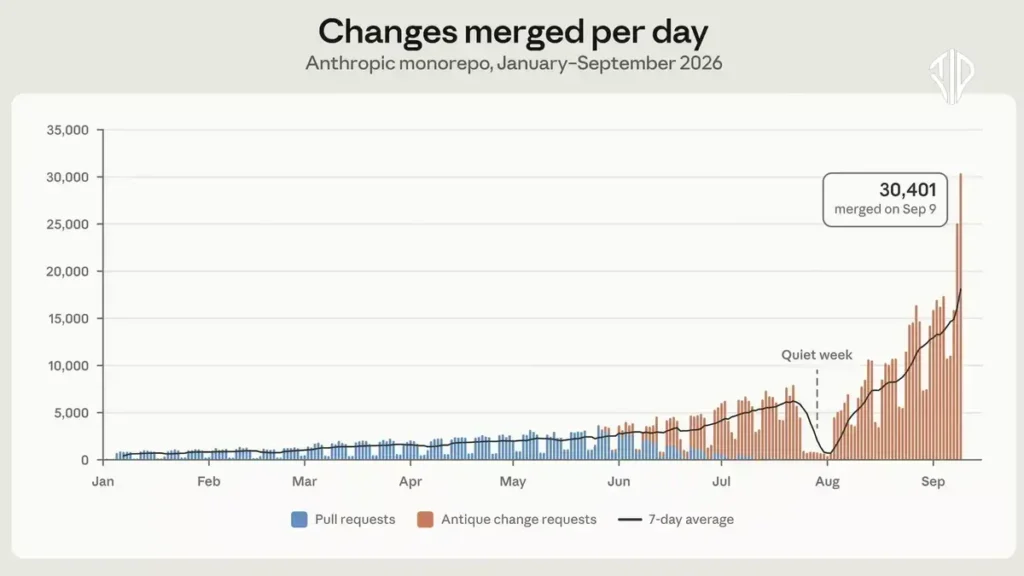
Anthropic reported that its internal automated systems averaged roughly 2,500 merged code changes per day in May. By September of that same year, that daily figure skyrocketed to more than 30,000 merged changes, driven largely by automated coding workflows powered by advanced AI models.
Attempting to process that volume through standard Git mirrors created severe resource bottlenecks. The company estimated that a naive implementation would generate more than 600 petabytes of daily network traffic just to handle continuous integration checkouts for every automated task.
Introducing Scion: A Server-Centric Version Control Architecture
To solve this infrastructure bottleneck, a small engineering team built a completely new internal version control system called Scion in just five months. Unlike Git, which requires clients to download and maintain a comprehensive local copy of the repository history, Scion centralizes most heavy lifting on remote servers.
Operations such as commits, merges, rebases, and file-history queries are executed directly on the server side. The client application primarily tracks local edits and maintains a limited cache, eliminating the need to download large amounts of unused repository data for every automated job.
This server-centric approach drastically reduces resource consumption. Anthropic noted that Scion uses a fraction of the CPU power and memory required by the previous Git mirror infrastructure, freeing up significant computing capacity for other engineering tasks.
Redefining Continuous Integration and Testing
The massive influx of AI-generated code also forced the company to rethink traditional software testing methodologies. In a high-volume environment where thousands of changes merge within minutes, relying on a global repository lock and pre-merge testing queues becomes impractical.
Instead, the workflow shifted toward rigorous automated testing occurring immediately after code merges take place but before final deployment. When merge conflicts occur, autonomous AI models are frequently deployed to resolve them quickly, demonstrating a closed-loop system where AI helps manage the output of other AI instances.
Interestingly, artificial intelligence also played a direct role in creating the solution itself. An early preview version of Anthropic’s own technology assisted engineers in rewriting key components of the Scion ingestion pipeline, helping the new software run significantly faster while consuming fewer resources.
Broader Implications for Software Development and Infrastructure
While Scion was custom-built for Anthropic’s specific operational scale and may not be immediately practical for standard software development teams, it highlights a crucial shift in modern engineering. As software engineering teams increasingly integrate generative coding assistants into their daily operations, supporting infrastructure must evolve to match machine-driven speeds.
Traditional tools will likely need to adopt server-side APIs and optimized fetching mechanisms to support environments where automated agents outpace human contributors. The transition signals that the future of software development will require reimagining foundational tools from the ground up to accommodate the realities of artificial intelligence at scale.
Key Takeaways
- Anthropic abandoned traditional Git version control because autonomous AI agents generated massive volumes of code exceeding standard tool capabilities.
- Daily merged code changes surged from 2,500 in May to over 30,000 by September, creating severe infrastructure bottlenecks.
- Engineers built Scion, a server-centric version control system that centralizes heavy processing on remote servers and minimizes local repository downloads.
- The company adapted continuous integration workflows by performing automated testing post-merge and using AI models to resolve merge conflicts.
- The evolution of version control highlights the urgent need for foundational software tools to adapt to machine-driven development speeds.
Join our community by subscribing to our Weekly Newsletter to stay updated on the latest AI updates and technologies, including the tips and how-to guides.
(Also, follow us on Instagram (@tid_technology) for more updates in your feed and our WhatsApp Channel to get daily news straight to your Messaging App).
